The Nobel Prize, established by the will of Swedish inventor Alfred Nobel in 1895, is an internationally recognized set of annual awards presented in six categories: Physics, Chemistry, Physiology or Medicine, Literature, Peace, and Economic Sciences. Nobel, the inventor of dynamite, dedicated the bulk of his significant fortune to the creation of a fund whose income would be distributed annually as prizes to those who, during the preceding year, “shall have conferred the greatest benefit to humankind.” The first Nobel Prizes were awarded in 1901, five years after Nobel’s death, and almost every year since, celebrating global human achievements in scientific discovery, literary excellence, and efforts toward global harmony. Today, the Nobel Prize maintains its relevance and global cultural impact: recipients receive significant media attention and bring recognition and pride to their respective countries. The long-lived impact of these awards has also brought scrutiny to the secretive selection process and the systemic biases within. This scrutiny and the continued relevance of the Nobel Prize are principal motivators for our project, in which we seek to uncover trends in the selection process and how a laureate’s country of origin (and other factors) impact(s) their chances at winning a prize, as well as the driving motivations behind their work and selection. We are using a dataset provided by the Nobel Foundation as a primary source for our analysis, which contains information on all prizes awarded from 1901 to 2016. The data reveals significant bias with a vast majority of laureates hailing from Western Europe countries as well as the United States (Data Visualization 3). For secondary sources we have collected a plethora of prior critical analyses on the history of the Prize as guiding motivations for our research.
The sources compiled in our annotated bibliography provide critical framing of the Nobel Prize’s history, influence, and the systemic factors affecting its distribution. Rather than solely celebrating individual achievement, the literature reveals that the awards often reflect and perpetuate global hierarchies and biases. Multiple scholars, including Crawford (1998) and Jewell (2000), point to clear geographical and cultural biases, noting a significant favoring of European and North American candidates that leaves other regions underrepresented. This trend is reinforced on one hand by studies like those from Inhaber and Przednowek (1976), which argue that prize winning is highly dependent on national- and institutional-level factors, such as strong educational systems and robust research funding, primarily built within a few wealthy countries.
On the other hand, scholars emphasize the active, systemic silencing of certain regions that is not solely a matter of access to resources, with Crawford highlighting that laureates from continents outside of Europe and North America are excluded irrespective of the quality of their work, but rather as a result of the homogeneity and discrimination present in confidential selection committees. Studies by Neikirk et al. (2024) and Rodríguez (2022) expose biases in gender and ethnic representation, detailing a skew toward white male recipients, often linked to the lack of diversity on nomination committees. Despite this, Goran Hansson, the head of the Royal Swedish Academy of Sciences, claims that the committee does “not have quotas for gender or ethnicity”.
If given more time, we would further wish to investigate more specific individuals and how their stories align with their nominations, their research, and their Nobel Prize. Although the nominations are not revealed until after 50 years, it would be interesting to look at the previous nominees, and to find any patterns within them.
Our investigation regarding the Nobel Prize laureates shows that their origin country holds a significance in the resulting prize presentation, as well as a variety of factors impact the choices that the Norwegian Nobel committees make. We uncovered the reasoning behind why these decisions were made, and to find commonalities between researchers and their nominations. We have visualized the pattern behind Nobel Prizes, to find out how the committees make their seemingly unbiased and majority-vote decisions. In doing so, we can help others understand that the Nobel Prize, although it is one of the highest honors one can receive, may have an undertone of bias within the committee. Many scholars, such as Alhuzalu and Jewell, note that the committees hold strong prejudices and limited worldwide perspectives, causing them to be underrepresented in many countries–especially non-Western ones. There are debates regarding the prestige and contributions of the winners, as well as a customized, monetary prize. Many individuals disagree with the committee’s decisions, which can cause international discourse and further investigation of the committee and how they can be politically motivated, or potentially misguided in their choice of the winner. Since the Nobel Prizes are awarded based on nominations from already credible scholars, this system creates an echo chamber: in which the winners continue to nominate one another, or their same institution, resulting in more winners from the same country. This begs the question of how the Nobel Prize winner may be chosen subjectively, rather than objectively, as our analysis and data visualizations show.
Further investigation is needed to show more concrete correlations behind the Nobel Prize winners and each committee’s choice behind them, but the achievement of the Nobel Prize remains one of the world’s most distinguished honors. The prize’s prestige and visibility is long sought for, and should be able to be won without discrimination or committee bias.
Data Visualizations
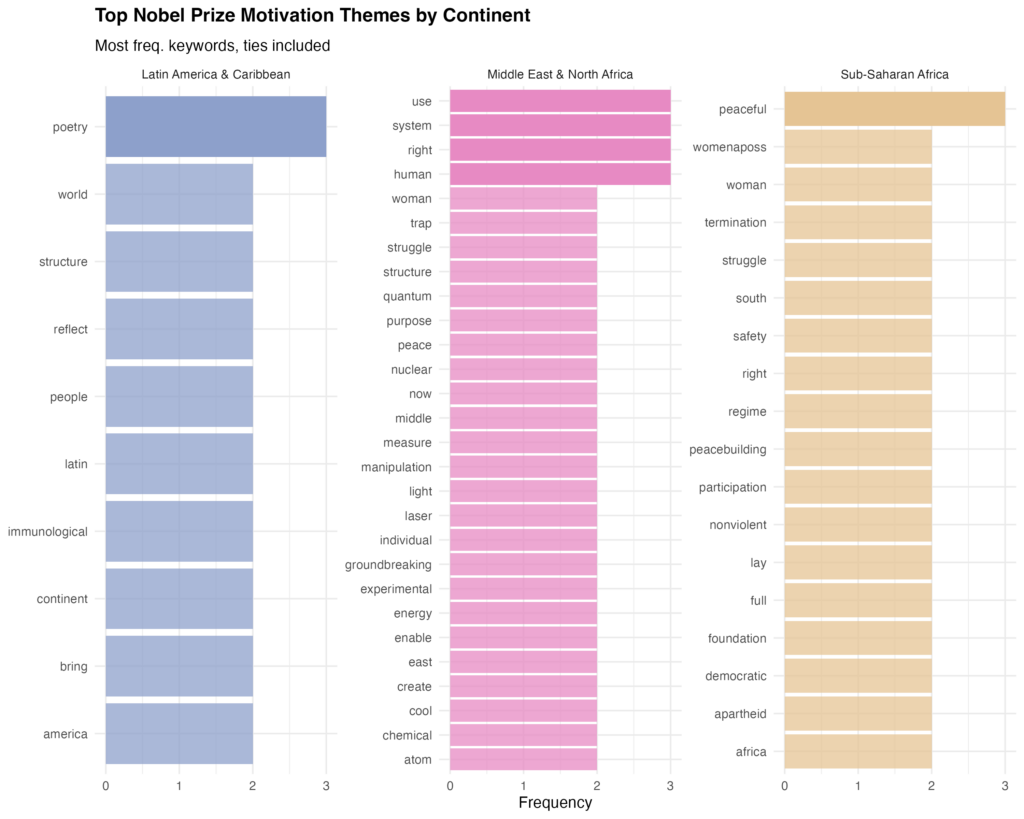
Data Visualization 1: Top Nobel Prize Motivation Themes by Continent (Latin America & Caribbean vs. Middle East & North Africa vs. Sub Saharan Africa)
Latin America & Caribbean
In this region, “poetry” stands out as the most frequent term, appearing more often than any other keyword. The remaining words appear twice each (e.g. world, structure, reflect, people, Latin, etc.) This pattern suggests that the Nobel motivations tied to this region emphasize cultural and literary recognition rather than scientific or policy-focused themes. It aligns with the region’s strong representation in Literature laureates (e.g., Neruda). This also reinforces how cultural production is central to why individuals from this region are awarded.
Middle East & North Africa
This region shows a much wider spread of terms (hence why there’s more bars), most tied at the same frequency. Top keywords include use, system, right, human, woman, and trap. Here we see overlapping thematic domains: human rights, gender, geopolitical struggle, and science. The presence of scientific words (e.g., quantum, atom, experimental) alongside political and social ones (e.g., peace, human, east) suggests mixed recognition across disciplines, from physics innovations to peace advocacy. This variation implies that laureates from this area receive awards tied to technological advancement as well as social justice, revealing this region as a site of both scientific innovation and political conflict.
Sub-Saharan Africa
The strongest recurring word is “peaceful,” followed by related terms like woman, struggle, apartheid, democratic, and nonviolent. Nearly every word in this set relates to political transformation or social justice movements. Terms like apartheid and regime explicitly reference historical power struggles. Sub-Saharan Africa’s cluster shows a clear thematic concentration around peace and political liberation. In other words, the Nobel institution most frequently frames African achievements through the lens of reconciliation and activism rather than scientific discovery or artistic contribution.
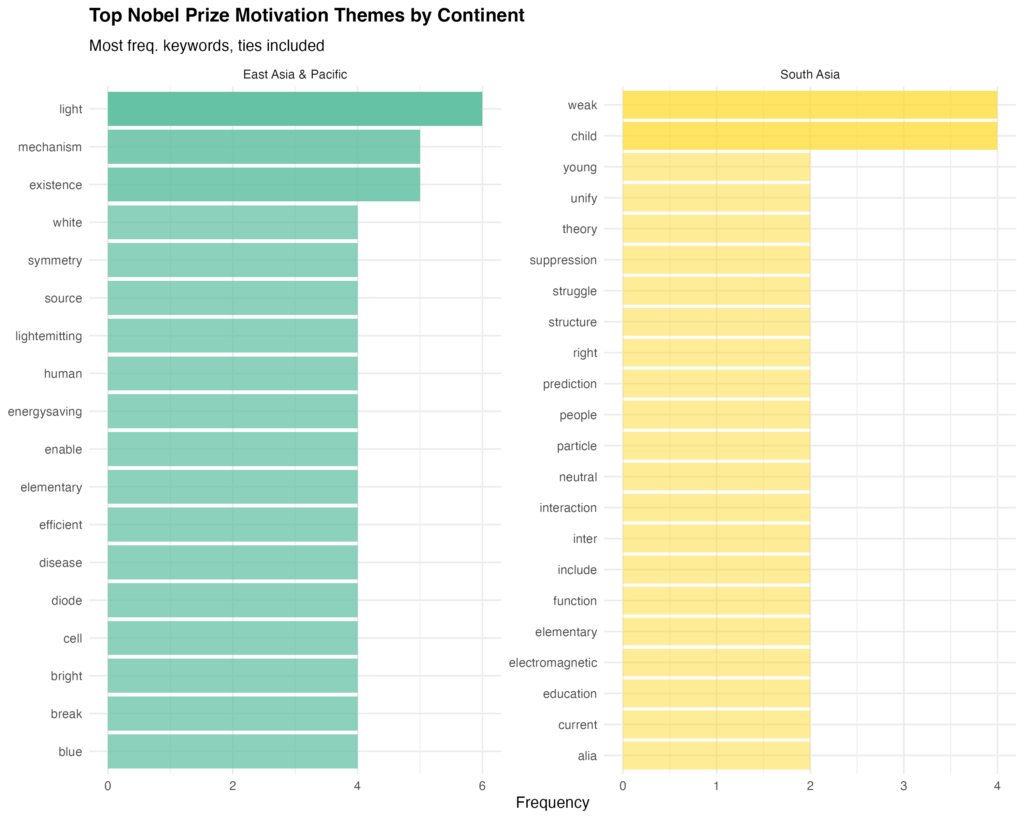
Data Visualization 2: Top Nobel Prize Motivation Themes by Continent (East Asia & Pacific vs. South Asia)
East Asia & Pacific
In this region, the highest-frequency keyword is “light,” appearing noticeably more than any other term. Many of the remaining frequent words relate to technological and scientific precision, including mechanism, symmetry, source, elementary, diode, cell, efficient, human, energy-saving, and blue.
Taken together, this set strongly reflects material science, physics, and engineering milestones. This is consistent with laureates from Japan and other East Asian nations whose prizes recognize inventions like blue LEDs and fiber optics. The emphasis on precise scientific language suggests the Nobel Committee frames East Asia primarily through technical innovation and applied research, positioning the region as a site of scientific production.
South Asia
The most frequent keywords for South Asia include “weak” and “child” followed by terms like young, struggle, suppression, education, right, and unify. Instead of technical language, these keywords imply politics, social inequality, and human development.The words “child” and “education” align closely with South Asian peace laureates advocating for youth empowerment and schooling, especially figures recognized for fighting suppression and championing girls’ rights (e.g. Kailash Satyarthi). Terms like “weak,” “struggle,” and “neutral interaction” point to discourses where South Asian achievements are framed through resilience against adversity.
In this region, “poetry” stands out as the most frequent term, appearing more often than any other keyword. The remaining words appear twice each (e.g. world, structure, reflect, people, Latin, etc.) This pattern suggests that the Nobel motivations tied to this region emphasize cultural and literary recognition rather than scientific or policy-focused themes. It aligns with the region’s strong representation in Literature laureates (e.g., Neruda). This also reinforces how cultural production is central to why individuals from this region are awarded.
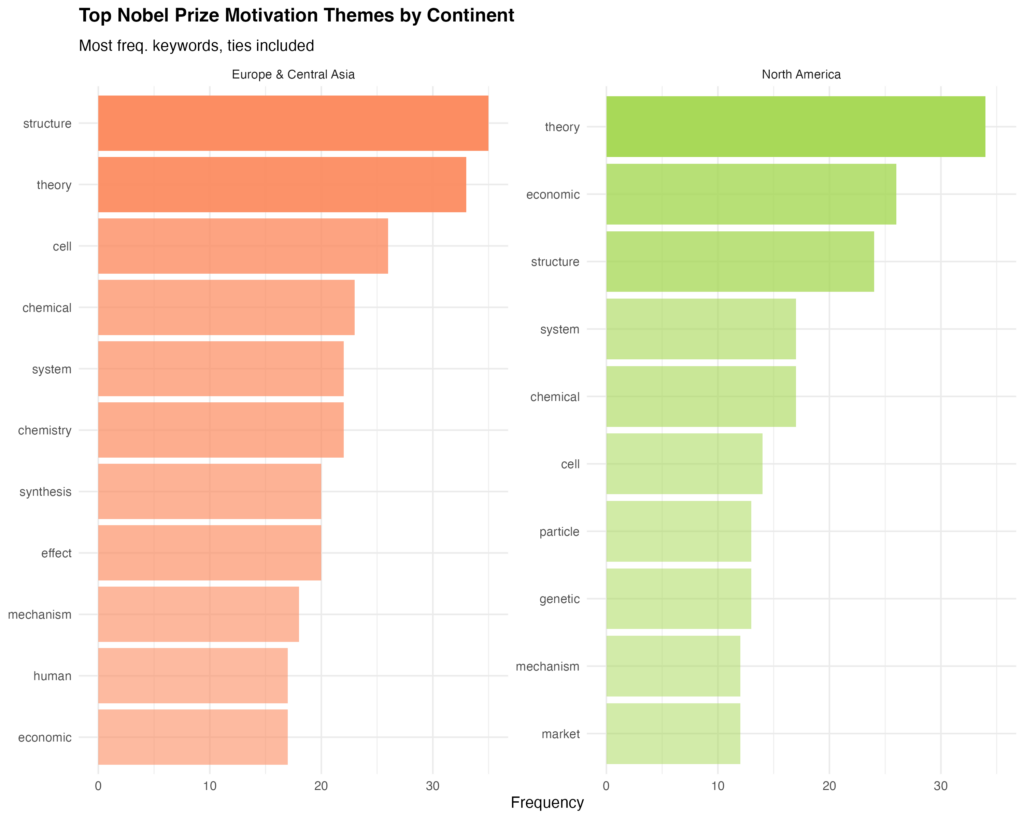
Data Visualization 3: Top Nobel Prize Motivation Themes by Continent (Europe & Central Asia vs. North America)
Europe & Central Asia
The most common terms include “structure,” “theory,” “cell,” “chemical,” and “system.” These words are largely tied to experimental sciences, particularly chemistry and molecular biology. The remaining frequent terms also further reinforce technical knowledge production, especially at the cellular or material scale.
This cluster suggests that Europe and Central Asia are narratively positioned as foundational scientific regions, where Nobel justification foregrounds breakthroughs in understanding how matter, cells, and mechanisms operate. These are knowledge building achievements, due to that the language emphasizes theoretical discovery, structural explanation, and scientific method.
North America
North America’s top keywords, particularly “theory” and “economic” indicate exceptionally high recognition for conceptual, model building forms of achievement. This aligns with North America’s heavy representation in economics, theoretical sciences, and market driven disciplines. Notably, these terms appear far more frequently than similar words in other regions: for instance, “economic” is the second most common keyword here, but it falls to the bottom of the list for Europe & Central Asia.
Frequent words like “structure,” “chemical,” “cell,” and especially “market” suggest that North America is seen as a place where science and economics are tightly linked. The keyword “market,” which barely appears in other regions, highlights something unique: North America is not just rewarded for scientific discoveries, but also for ideas about how economies systems should work.
The widened scale across this graph compared to earlier ones is not just a formatting choice: it encodes power. It visually demonstrates where Nobel discourse is densest around Europe and North America.
Data Visualization 4: Top 20 Countries by Nobel Laureate Births
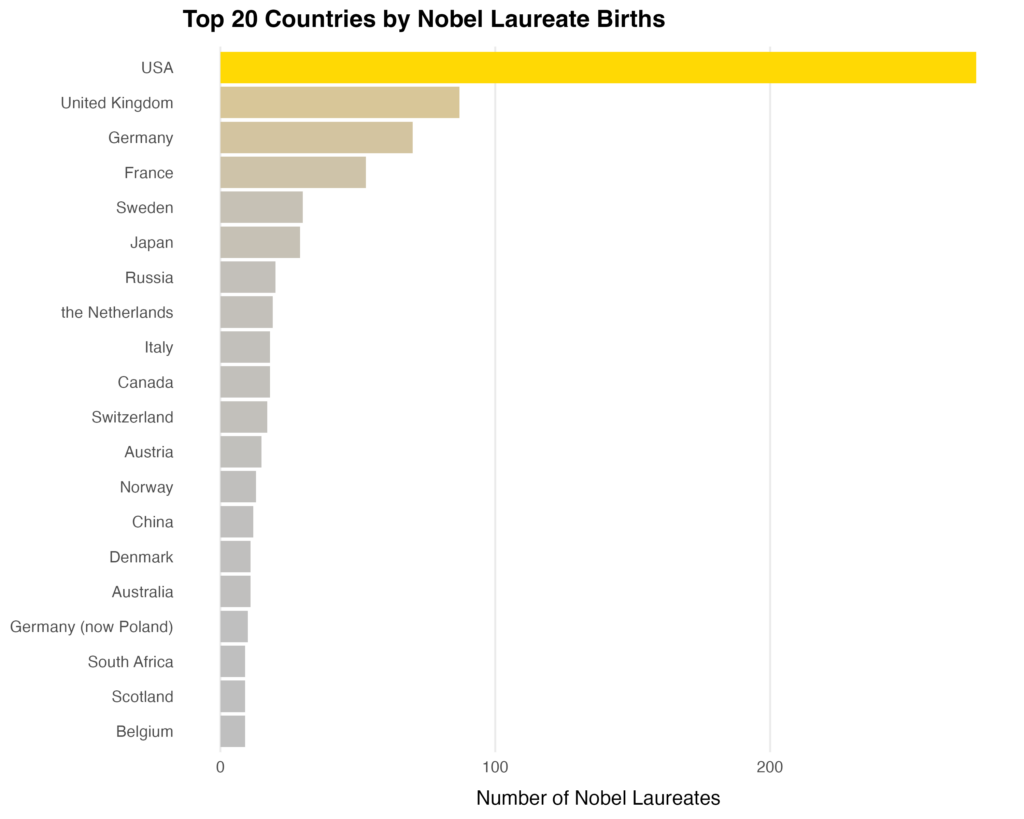
The horizontal bar chart displays the top 20 countries with the highest number of Nobel laureates by country of birth. The United States dominates all other nations, followed by Unites Kingdom, Germany, and France. The USA’s bar stretches to nearly 300 laureates, creating a scale that visually dwarfs all other countries. This single bar forces the x axis to expand dramatically, making even high performing European countries appear small in comparison. This is a crucial visual effect, because the size of the U.S. bar doesn’t just indicate numerical dominance; it reshapes the entire chart and highlights the extent of this imbalance. The bottom part of the list includes countries such as China, Australia, South Africa, Scotland, and Belgium, each with relatively few laureates compared to the dominant Western nations. Their presence shows that Nobel laureates do uneven emerge globally.
Data Visualization 5: Top 20 Countries by Nobel Laureate Births (USA excluded)
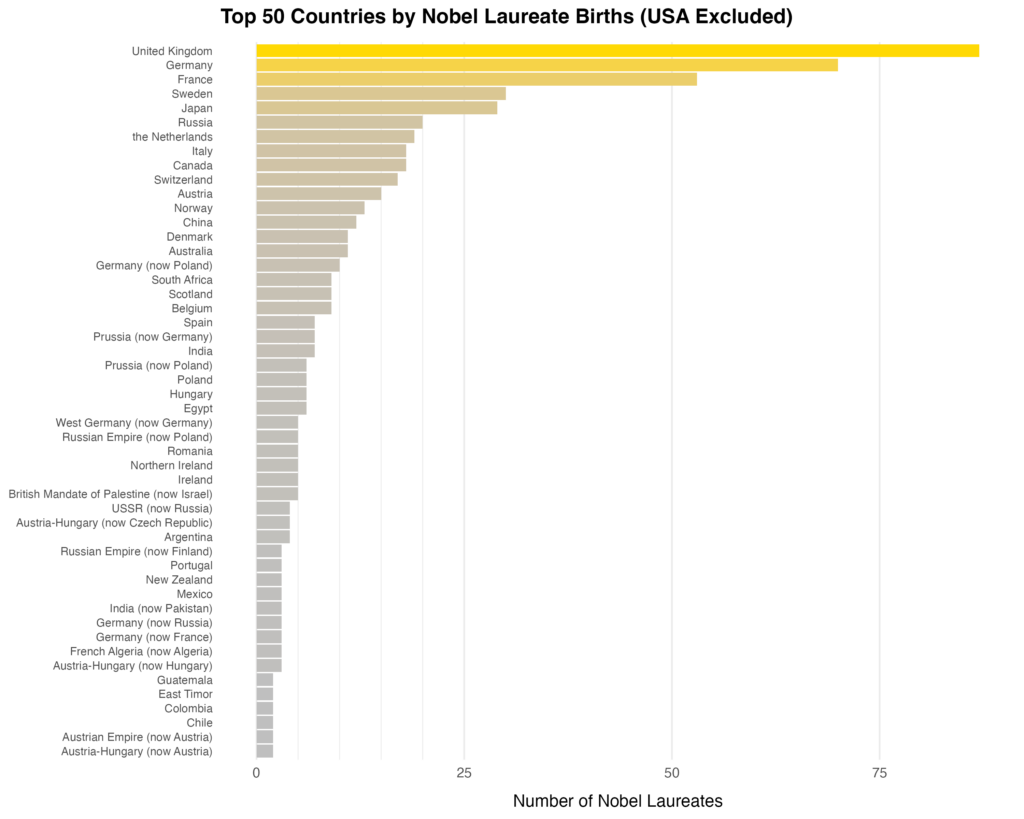
The bar chart removes the United States to better reveal patterns among the remaining countries. With the U.S. excluded, the United Kingdom becomes the leading country, followed by Germany and France. These three nations stand far ahead of all others, with bar lengths that extend dramatically further than the rest, visually signaling their disproportionate representation. Below them, countries like Sweden, Switzerland, Austria, Italy, and the Netherlands appear next, forming a dense cluster of Western European nations with moderate numbers of laureates. This geographic concentration suggests that the Nobel archive strongly reflects European intellectual history, especially that of Northern and Western Europe, because they are regions long associated with institutionalized research universities, laboratories, and state funded science. The chart shows that there are still countries that make small, yet meaningful contributions such as Prussia and Austria Hungary. This visualization emphasized how Nobel recognition is distributed across national boundaries.
Data Visualization 6: Geospatial Heatmap of Nobel Laureates
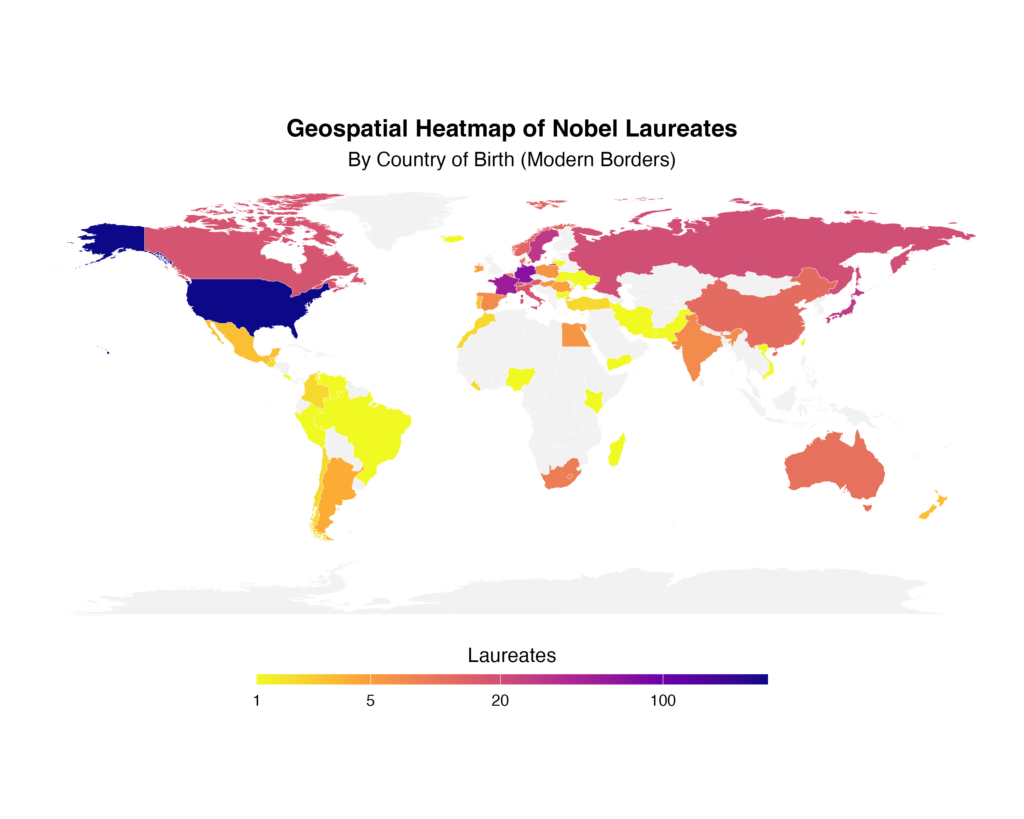
The mapping visuals the density of Nobel laureates based on their birth countries. The darker colors represent higher numbers of laureates. The United States and Western Europe appear darkest, indicating the highest concentrations. Parts of East Asia and Australia show moderate representation while most of Africa and South America appear lighter. The heatmap visually reinforces patterns shown in the bar charts above as well. These patterns align with the broader argument that the Nobel Prize both reflects and reproduces global power structures, elevating achievements from already privileged regions while underrepresenting others. Nobel laureates are overwhelmingly born in wealthy and industrialized countries. The United States and Western Europe dominate to such an extent that they reshape the entire visualization’s color scale. The Global South’s minimal coloration highlights stark geographic inequality in who becomes recognized as a producer of global knowledge.
Data Visualization 7: Nobel Laureates by Born Continent
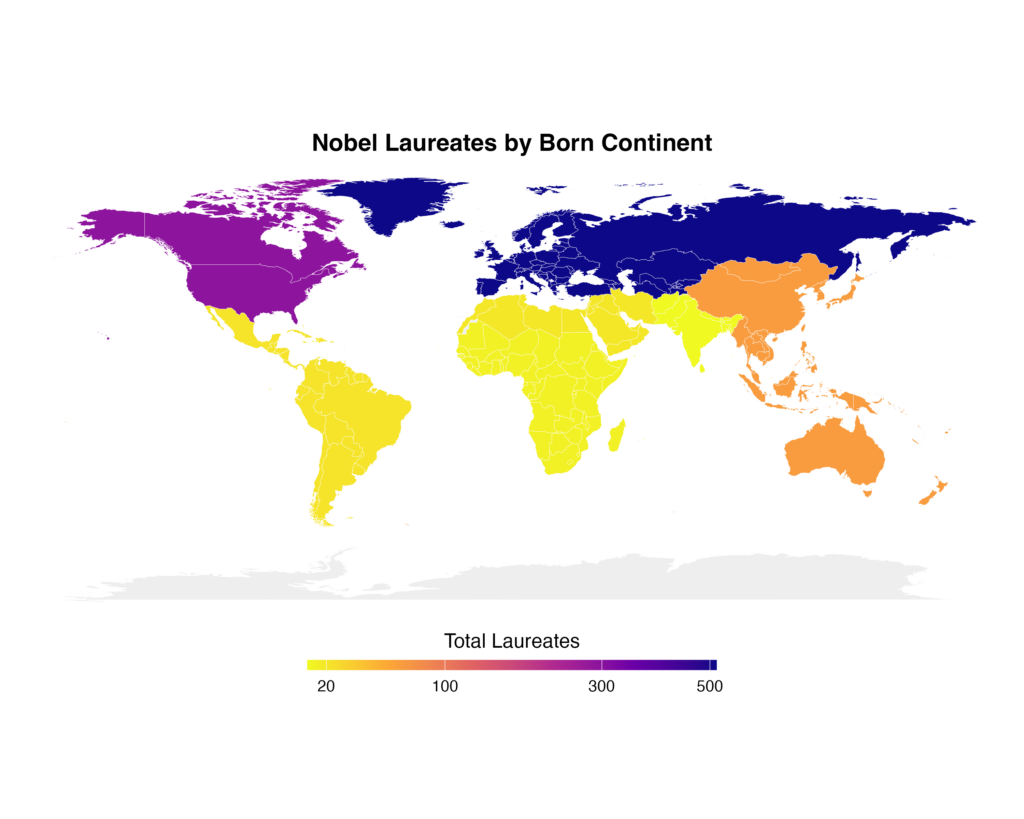
This mapping aggregates Nobel laureates by continent of birth. Europe shows the darkest color intensity, indicating the highest total number of laureates, followed by North America. Asia shows moderate representation while South America and South Africa have substantially lower totals. The lightest shades often correspond to only a handful of laureates, signaling a stark geographic inequality in recognition. This aligns with earlier results showing these regions are framed in Nobel discourse mainly through peace, struggle, humanitarian work, or literature (not high frequency scientific or economic innovation). Most of the world appears in low total colors, while only two continents takeover the scale. This visualization highlights the dominant role of Europe and North America in producing Nobel Prize winners.